

The term "dr registrar" appears frequently in hospital rosters, recruitment briefs, and credentialling documents, yet its meaning varies depending on context, geography, and specialty. In Australia, a registrar occupies a distinct position in the medical workforce hierarchy-above junior medical officers, below consultants, and squarely in the middle of specialist training. Understanding what a dr registrar is, how the grade functions, and where locum placement fits becomes essential for anyone working with hospital staffing or considering advanced training pathways.
What a Dr Registrar Is in Australian Hospitals
A dr registrar is a qualified medical practitioner undergoing specialist training within a recognised college program. They hold general registration with AHPRA, have completed internship and at least one year of residency (often more), and are working toward a specialist qualification such as FRACS, FRACP, or FANZCA. The registrar grade is not a job title in isolation-it represents a stage of supervised training where the doctor assumes increasing clinical responsibility under the oversight of a consultant.
The distinction between a registrar and a resident is sometimes unclear to those outside the hospital system. Residents (RMOs, JMOs) rotate broadly across disciplines and are not yet committed to a specialty training pathway. Registrars have entered a specific college program, and their rotations are structured to meet curriculum requirements. A dr registrar in Emergency Medicine will complete terms in trauma, resuscitation, and toxicology; a registrar in Obstetrics and Gynaecology will rotate through antenatal clinics, operating theatres, and high-risk pregnancy units.

Hospitals employ registrars on fixed-term contracts aligned with training rotations, typically six to twelve months. Some registrars are "unaccredited"-they hold the job title and perform the clinical work of a registrar but are not in a formally accredited training position. These unaccredited terms still count toward experience but may not satisfy college requirements for progression. The NHS Employers' Terms and Conditions Handbook outlines similar distinctions in the UK system, where training grades and service grades operate in parallel.
Training Requirements and College Progression
Every dr registrar is accountable to a specialist college. In Australia, the Royal Australasian College of Surgeons (RACS), Royal Australasian College of Physicians (RACP), Australian and New Zealand College of Anaesthetists (ANZCA), and others set the curriculum, examinations, and rotation requirements. Progression through registrar training is not simply a matter of time served-it depends on completion of logbook cases, structured assessments, and formal examinations.
For surgical registrars, progression includes SET (Surgical Education and Training) selection, which is highly competitive. A doctor may spend years as an unaccredited surgical registrar before gaining a SET position. Physician registrars follow Basic and Advanced Training stages, each with its own written and clinical exams. Anaesthetic registrars rotate through obstetric, paediatric, and cardiac anaesthesia terms, building supervised case numbers toward fellowship.
| Specialty | Training Duration | Key Examinations | Typical Rotations |
|---|---|---|---|
| Emergency Medicine | 5 years | Primary, Fellowship | Metro ED, regional ED, paediatric ED, trauma |
| Anaesthetics | 5 years | Primary, Final | Obstetrics, paediatrics, ICU, pain, cardiac |
| Physician Training (RACP) | 6+ years | Written, Clinical | General medicine, subspecialty, ICU, rural |
| Surgery (RACS) | 5 years (SET) | Part 1, Part 2 | Elective, emergency, vascular, orthopaedics |
| Psychiatry | 5 years | Written, OSCE | Acute inpatient, community, consult-liaison, forensic |
The Royal College of General Practitioners' hub for GP registrars provides a comparable framework in the UK, though the structure differs. Australian colleges maintain tighter control over accreditation and rotation approval, meaning a dr registrar's career progression hinges on securing accredited terms in the right hospitals.
Clinical Responsibilities and Supervision Models
A dr registrar carries significant clinical autonomy compared to junior doctors. On a surgical roster, the registrar often leads the operating list under consultant supervision, makes independent decisions in the emergency theatre, and supervises residents and interns on the ward round. In an Emergency Department, the registrar triages complex cases, manages resuscitations, and signs off on junior staff presentations.
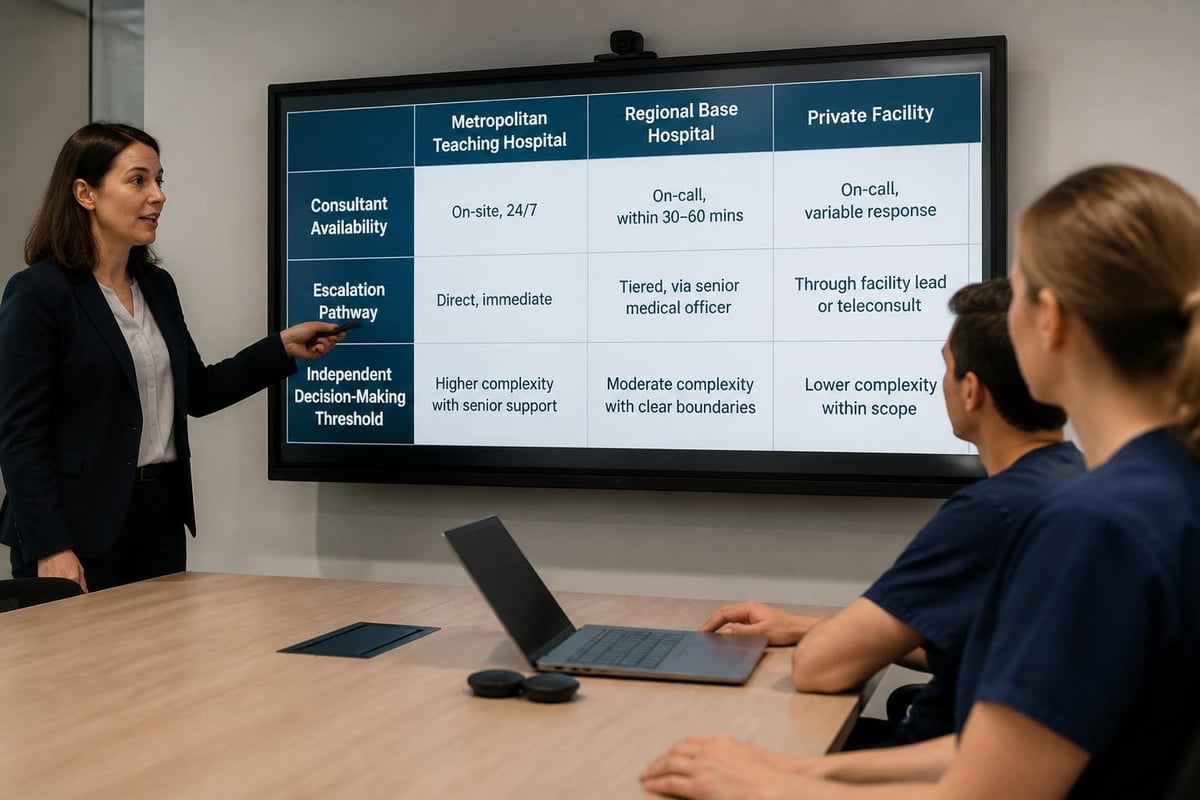
Supervision varies by specialty and hospital. In a metropolitan teaching hospital, a registrar may have direct consultant oversight throughout the shift. In a regional or private facility, supervision might be indirect-consultants available by phone, with the registrar managing the floor independently. This variation has implications for locum placement. A dr registrar accustomed to close supervision in a tertiary centre may find a regional placement challenging if the support structure is unfamiliar.
The level of independence also affects credentialling. Hospitals credential doctors based on scope of practice, and a registrar's scope is narrower than a consultant's but broader than a resident's. Before placing a dr registrar in a locum role, agencies verify that the doctor's current training stage aligns with the facility's expectations. Registrar and JMO Placement requires understanding these distinctions-placing a first-year physician registrar in a role expecting advanced trainee experience creates clinical risk.
Locum Work for Registrars
Locum placements at the registrar level fill gaps in rosters when permanent or rotation registrars are unavailable due to leave, unfilled positions, or short-notice absences. Unlike consultant locums, where the doctor operates independently, a dr registrar locum still requires the same supervision framework as a permanent registrar. This means the receiving facility must have consultant cover in place.
Short-term locum shifts are common in Emergency Medicine, Anaesthetics, and Psychiatry, where rosters are shift-based and flexibility is built into the structure. Surgical and Obstetrics registrar locums tend to be block placements-covering parental leave or extended sick leave-because the role involves continuity across elective lists and on-call commitments.
A dr registrar considering locum work needs to ensure the placement aligns with training requirements. Some colleges allow unaccredited terms to count toward experience if the clinical work matches curriculum objectives. Others are stricter. A surgical registrar in a SET program may not be able to take a locum placement in a non-accredited hospital without college approval. Physician registrars have more flexibility, particularly in Basic Training, but Advanced Trainees are often restricted to accredited sites.
From a facility perspective, the credentialling burden for a registrar locum is the same as for a permanent appointment. AHPRA registration, medical indemnity, immunisation records, and specialty-specific requirements all apply. The placement is not faster simply because the doctor is a registrar rather than a consultant-the verification process is identical.
Pay Rates and Employment Terms
Registrar pay in Australia is governed by enterprise agreements (public sector) or individual contracts (private sector). In NSW public hospitals, registrars fall under the Staff Specialists and Senior Medical Officers Award, with rates ranging from approximately $90,000 to $140,000 base salary depending on training year and specialty. Overtime, on-call allowances, and penalties significantly increase total compensation.
Locum rates for a dr registrar are typically higher than permanent employment equivalents on an hourly basis, reflecting the absence of leave entitlements and job security. A registrar working a locum shift in Emergency Medicine might earn $120–$180 per hour depending on the time of day, day of the week, and facility location. Regional placements often attract higher rates due to travel and accommodation costs.
| Employment Type | Hourly Rate (indicative) | Leave Entitlements | Superannuation | Notice Period |
|---|---|---|---|---|
| Permanent Registrar | $70–$95 | Yes | 11% | 4 weeks |
| Locum Registrar | $120–$180 | No | Paid separately | Shift-by-shift |
| VMO Registrar (private) | $150–$200 | No | Self-managed | Contract-specific |
Private hospitals sometimes engage registrars as Visiting Medical Officers (VMOs) on a sessional basis, particularly in Anaesthetics and Obstetrics. These arrangements differ from employment contracts-the doctor invoices for sessions worked, manages their own tax and insurance, and has no employer-employee relationship with the facility. The example NHS trust job description for a Trust Doctor at Registrar Level illustrates comparable employment structures in the UK, where registrar-level doctors may be employed on fixed-term or locum contracts depending on service need.
Credentialling and Facility-Specific Requirements
Before a dr registrar can work in any Australian hospital, they must be credentialled. Public hospitals follow state health department frameworks; private hospitals follow facility-specific processes. Both require verification of qualifications, registration, and indemnity, but private hospitals often add additional checks such as reference calls and peer review.
The credentialling standard for a registrar is the same whether the doctor is permanent or locum. The facility needs evidence that the doctor's training stage matches the role's clinical expectations. A third-year anaesthetic registrar credentialled for obstetric anaesthesia cannot be placed in a cardiac anaesthesia role without further review. Scope of practice is specialty-specific and must be documented.
Locum agencies handling registrar placements manage this process on behalf of the facility and the doctor. The agency collects current AHPRA registration, indemnity certificates, immunisation records, and a CV detailing training progression. For accredited training positions, the agency confirms college enrolment and current rotation approval. For unaccredited placements, the agency clarifies whether the role will count toward training time and whether the doctor has approval from their college to take it.

Regional and Interstate Placements
Registrars working in regional or remote hospitals gain exposure to clinical scenarios rarely seen in metropolitan centres. A surgical registrar in a regional base hospital may be the most senior doctor on-site overnight, managing trauma and emergency surgery with consultant support by phone. An Emergency Medicine registrar in a rural hospital covers paediatrics, obstetrics, and general medicine in addition to trauma and resuscitation.
These placements build clinical confidence but require a different mindset. The support structure is thinner, the patient mix is broader, and the registrar must be comfortable making decisions without immediate consultant presence. Not every dr registrar is suited to this environment, and agencies placing registrars in regional roles need to brief the doctor on what to expect before they commit.
Interstate placements introduce additional complexity. Each state health department has its own credentialling requirements, and some require facility-specific orientation even for experienced registrars. A dr registrar credentialled in NSW cannot automatically work in Queensland or Victoria without completing the receiving state's onboarding process. Locum agencies managing interstate placements handle these logistics, but the lead time is longer than for intrastate work.
The Royal College of Physicians of Ireland project updates on internal medicine training restructuring describe similar challenges in coordinating registrar training across different health regions, where governance, supervision standards, and curriculum approval vary by location.
Roster Gaps and How Registrar Locums Are Sourced
Hospitals forecast registrar vacancies months in advance, but gaps still appear due to resignations, parental leave, or failed recruitment. Emergency Departments, ICUs, and Obstetrics units are particularly vulnerable because registrar rosters are shift-based and vacancies disrupt service continuity.
When a gap opens, the hospital's medical workforce unit assesses whether the role can be backfilled internally (existing staff covering extra shifts) or whether external locum cover is required. If external, the hospital contacts locum agencies with a brief: specialty, shift dates, required training level, and supervision arrangements. The agency then searches its database for registered doctors who meet the criteria.
Speed matters. A dr registrar vacancy in an Emergency Department roster might be notified only 48 hours before the shift. The agency needs to identify a suitable doctor, verify credentials, and confirm availability within that window. This is where agencies with established relationships and pre-verified doctor pools have an advantage. A doctor already credentialled at the facility can be placed faster than one requiring a full credentialling review.
For longer-term gaps-parental leave cover, extended sick leave-the recruitment process resembles a permanent appointment. The facility interviews candidates, checks references, and may require the doctor to complete a trial shift before confirming the placement. These placements can run for three to twelve months and are treated as fixed-term contracts rather than casual locum shifts.
Training Continuity and Locum Flexibility
A dr registrar's primary obligation is to their training program. College requirements, rotation timelines, and examination dates take precedence over locum work. This creates tension: locum shifts offer higher pay and schedule flexibility, but too much unaccredited locum work can delay training progression.
Some registrars use locum work strategically. Between rotations, during gaps in accredited positions, or while preparing for exams, a registrar might take short-term locum shifts to maintain income and clinical exposure without committing to a full rotation. Others avoid locum work entirely, prioritising accredited terms and training progression above financial considerations.
Agencies placing registrars need to understand these competing priorities. A dr registrar contacted about a three-month locum placement in a regional ICU will want to know whether the term is accredited, whether it aligns with their current training stage, and whether their college will recognise the experience. If the answers are unclear, the doctor will decline regardless of the pay rate.
The typical Specialty Registrar vacancy listing on NHS Jobs shows how UK hospitals advertise registrar roles with clear statements about training accreditation, supervision arrangements, and progression pathways-details that matter as much as salary in a registrar's decision-making.
Common Misconceptions About the Registrar Grade
One persistent misconception is that a dr registrar is equivalent to a consultant in training-close enough to consultant level that supervision is optional. This is incorrect. A registrar is a trainee, and the entire training structure depends on consultant oversight. Placing a registrar in a role without adequate supervision is a clinical governance failure.
Another misconception is that all registrars are in accredited training programs. In reality, a significant proportion work as unaccredited registrars, particularly in surgery and anaesthetics. These doctors perform the same clinical work as accredited registrars but occupy service positions rather than training positions. Their career progression depends on securing an accredited spot, which may take years.
A third misconception relates to flexibility. Because locum work is often described as flexible, some assume a dr registrar can pick up ad hoc shifts without affecting their training. This is true only to a point. Too many unaccredited shifts, or shifts outside the registrar's specialty, can delay college progression or result in the doctor being asked to justify their training timeline.
Understanding these realities is essential for anyone involved in hospital staffing, whether as a facility manager, recruitment consultant, or workforce planner. How to make locuming work for you explores the balance between flexibility and career progression in more detail.
How Facilities Manage Registrar Cover Shortfalls
When a hospital cannot fill a registrar vacancy through permanent recruitment or internal redeployment, it has three options: reduce service capacity, ask existing registrars to cover additional shifts (at penalty rates), or engage a locum. The third option is often the only viable one in high-acuity departments like Emergency Medicine and Anaesthetics.
Some facilities manage registrar rosters proactively, building relationships with locum agencies and maintaining a pool of pre-credentialled doctors who can be called on short notice. Others operate reactively, contacting agencies only when a gap appears. The proactive model reduces placement time and improves roster stability, but it requires investment in workforce planning.
Larger hospitals and health networks sometimes negotiate panel agreements with locum agencies, setting agreed rates and streamlined credentialling processes. Smaller regional hospitals typically engage agencies on a case-by-case basis, which can lead to longer lead times and higher fees.
From the registrar's perspective, working for a facility with established locum processes is preferable. The onboarding is smoother, the support structure is clearer, and the likelihood of last-minute cancellations or administrative confusion is lower. Medical staffing in regional areas: being prepared discusses the infrastructure needed to support locum placements in less-resourced settings.
The Role of Locum Agencies in Registrar Placement
Locum agencies act as intermediaries, matching doctors to facilities based on specialty, training level, availability, and credentialling status. For a dr registrar, the agency handles administrative tasks-invoice submission, travel booking, credentialling documentation-that would otherwise consume hours of the doctor's time.
Not all agencies handle registrar placements equally well. Agencies with clinical oversight-those employing doctors or senior clinicians as consultants-better understand the distinction between accredited and unaccredited roles, the importance of supervision, and the college requirements that govern training progression. Agencies without clinical oversight sometimes misplace registrars, creating frustration for the doctor and risk for the facility.
The best agencies verify not just AHPRA registration and indemnity but also the doctor's current training stage, college enrolment, and rotation approval. They brief the doctor on the facility's supervision model, patient mix, and escalation pathways before the shift. They confirm that the placement aligns with the doctor's training goals, or at least does not conflict with them.
For facilities, engaging an agency with registrar expertise reduces placement risk. The agency pre-screens candidates, verifies credentials, and provides 24/7 support if issues arise during the shift. This is particularly valuable for after-hours and weekend placements, when hospital workforce units are not staffed.
A dr registrar is not simply a mid-level hospital doctor-they are a trainee navigating a complex, high-stakes pathway toward specialist qualification, balancing clinical responsibility with college requirements and career progression. Understanding the registrar grade, its training obligations, and the role locum work plays within that framework is essential for effective medical workforce planning. Best Practice Medical connects hospitals with credentialled registrars across Emergency Medicine, Anaesthetics, Surgery, Obstetrics, Psychiatry, and other specialties, managing the credentialling, placement, and support logistics that allow facilities to maintain safe, continuous registrar cover even when permanent recruitment falls short.