

Doctors availability sits at the centre of every hospital's operational planning. When an anaesthetist books parental leave, when an ICU consultant resigns with eight weeks' notice, when a psychiatry registrar calls in sick two hours before shift start, the question becomes immediate: who's available, who's credentialled, and how fast can they get here? For hospital directors of medical services and nursing unit managers, understanding the forces that shape doctors availability means the difference between a covered roster and a scramble at 0600 on a Monday morning.
What Actually Drives Doctors Availability
Availability isn't static. A specialist might be available Tuesday through Thursday this fortnight but unreachable the next. Registrars finish rotations and leave the state. VMOs reduce sessions when private commitments increase. The factors that determine whether a doctor can take a shift span personal circumstances, regulatory requirements, and economic realities.
Registration status forms the first constraint. AHPRA registration must be current, with relevant specialist registration if the role requires it. A Fellow of the Royal Australian and New Zealand College of Anaesthetists working in anaesthetics is straightforward; a registrar in advanced training needs their training provider to approve any additional sessions outside their core rotation. Medical indemnity must cover the proposed scope of practice at the proposed location. These aren't negotiable.
Geographic location shapes availability more than most hospitals anticipate. A Sydney-based O&G specialist might accept a shift at Royal North Shore but decline Liverpool. An emergency physician living on the Central Coast won't drive to Campbelltown for a single night shift. Regional facilities face harder constraints: the available pool shrinks when the role requires relocation or extended travel. Interstate placements require a doctor willing to fly in, stay over, and manage the disruption to their home roster.

Credentialling timelines create artificial scarcity. A hospital needs an anaesthetist in three days, but credentialling the only available candidate will take a week. The gap isn't a shortage of doctors; it's a mismatch between urgency and process. Facilities with pre-credentialled locum panels reduce this friction, but most still require case-by-case verification. Understanding how long credentialling actually takes for each specialty and each facility type allows better advance planning when a known gap is approaching.
Roster conflicts limit availability even when a doctor would otherwise accept. A registrar finishing nights on Friday can't start days on Saturday at a different hospital. A VMO with a private list on Wednesday afternoon won't take a public session the same day. Fatigue management policies and award provisions restrict consecutive shifts and mandate minimum breaks between rostered duties. A doctor available in theory may be unavailable in practice once you layer in their existing commitments.
Measuring Availability Across Hospital Specialties
Different specialties demonstrate different availability patterns. Emergency medicine sees high locum activity because rosters run 24/7 and gaps are visible immediately. A missed shift means either another doctor stays late or the department runs under-staffed. Anaesthetics and ICU follow similar patterns: shift-based work, fixed rosters, clear gaps when someone's unavailable. Research on appointment wait times demonstrates that availability varies significantly across specialties and regions, with some markets showing wait times triple those of others.
Surgery and O&G operate differently. Elective lists can be rescheduled if a VMO is unavailable, though the downstream impact on waiting lists and patient flow is real. Availability here is less about immediate coverage and more about maintaining throughput. A facility short one surgical VMO for two weeks might postpone ten elective cases, creating a backlog that takes months to clear.
Psychiatry presents its own availability challenge. Inpatient psychiatry shifts need cover, but finding a psychiatrist willing to take a standalone shift in an unfamiliar unit is harder than finding an emergency physician for the same scenario. Psychiatric assessment depends on continuity and familiarity with local systems, involuntary treatment legislation, and the patient cohort. Availability often depends on whether the doctor has worked at that facility before.
The table below outlines typical availability constraints by specialty:
| Specialty | Primary Constraint | Secondary Constraint | Typical Notice Required |
|---|---|---|---|
| Emergency Medicine | Roster conflicts | Fatigue management limits | 48–72 hours |
| Anaesthetics | Credentialling at specific facility | Scope of practice verification | 5–7 days |
| ICU | Advanced life support currency | Facility-specific protocols | 5–10 days |
| Surgery (VMO) | Theatre availability alignment | Private practice commitments | 2–4 weeks |
| O&G | Obstetric indemnity specifics | On-call availability alongside | 1–3 weeks |
| Psychiatry | Unit familiarity | Involuntary treatment training | 1–2 weeks |
| Paediatrics | APLS/NRP currency | Child protection training | 1–2 weeks |
Rural and Regional Doctors Availability
Regional and rural hospitals face a structurally different availability problem. The issue isn't just fewer doctors per capita; it's fewer doctors willing to relocate or travel for short-term cover. A metropolitan tertiary hospital drawing from a city of five million will always have more available doctors within thirty minutes' drive than a base hospital three hours inland drawing from a town of fifteen thousand.
Federal analysis of rural healthcare access highlights that workforce shortages in rural areas are not purely a supply issue but also a distribution and retention challenge. Doctors are available in aggregate; they're not available where they're needed. For hospital managers in regional centres, this means availability depends heavily on travel logistics, accommodation quality, and the doctor's willingness to work in an environment different from a metro teaching hospital.
Fly-in, fly-out models improve doctors availability in remote locations, but they introduce new dependencies. Flight schedules dictate start times. Weather can delay or cancel arrivals. A locum delayed by fog in Sydney doesn't arrive in Dubbo on time, and there's no backup within the local area. Managing this requires redundancy: multiple doctors on standby, or a willingness to extend the outgoing doctor's shift while the replacement travels.
Recruiting a doctor for a three-month regional placement is easier than filling three single weeks across three months. Availability improves when the commitment is long enough to justify relocation but short enough to remain classified as locum work rather than a permanent move. Doctors finishing training often take extended rural locums before settling into metro private practice. Tapping into this cohort requires understanding the rhythms of training program calendars and fellowship exam schedules.
How Roster Management Affects Perceived Availability
What looks like a doctors availability problem is often a rostering problem. A hospital struggling to fill anaesthetic shifts might have enough anaesthetists in the region, but their existing commitments don't align with the hospital's gaps. Reactive rostering-waiting until someone calls in sick, then scrambling to find cover-guarantees poor availability because you're always filling at the last minute when the available pool is smallest.
Proactive rostering identifies gaps weeks ahead and starts sourcing before the gap becomes urgent. A facility that knows a senior registrar finishes their rotation on March 15 should be sourcing the replacement in January, not March 10. For hospitals managing ongoing or complex locum requirements, partial or full roster management services allow external teams to plan ahead, identify gaps, and maintain continuity of cover across departments, reducing the perception of scarcity that comes from late-stage recruitment.
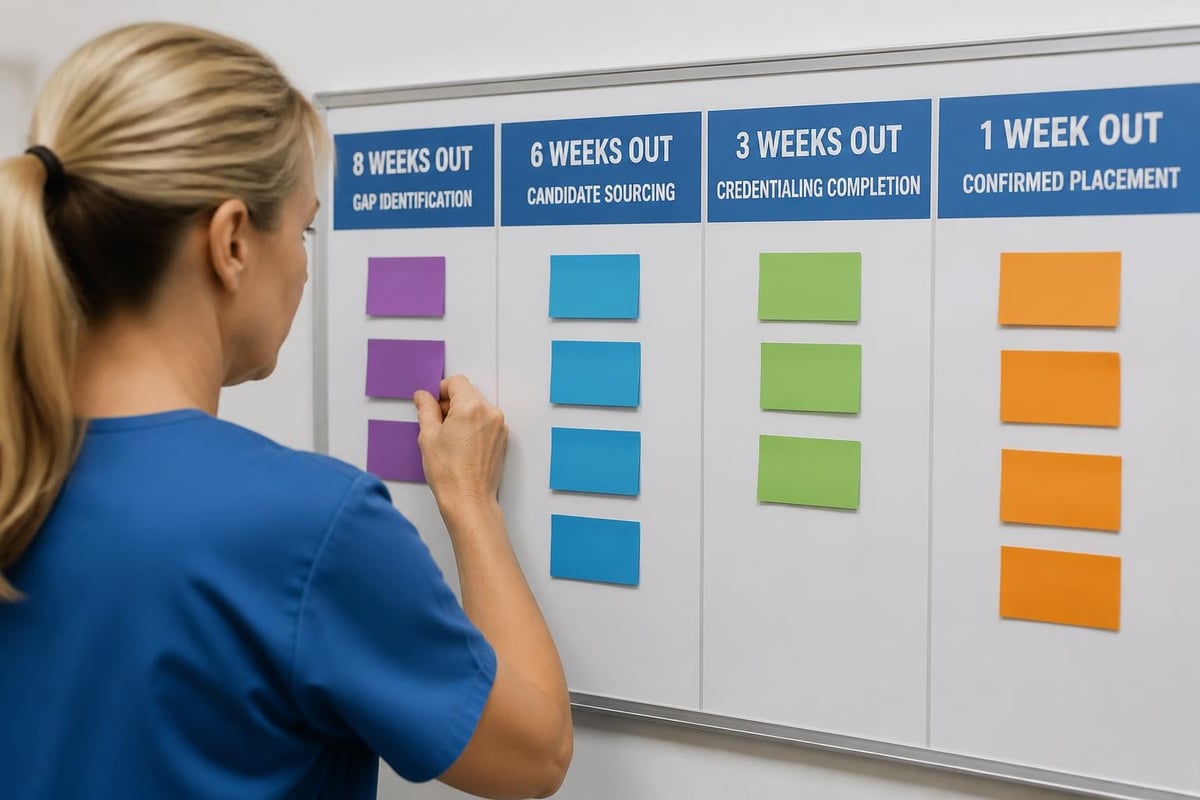
Advance planning also improves the quality of available candidates. Doctors who plan their work a month ahead are often more experienced, more reliable, and less likely to cancel last-minute than those picking up shifts the day before. The most sought-after locums are booked weeks in advance; if a facility only reaches out at the last minute, it's competing for whatever availability is left.
Fatigue limits must also be factored into availability planning. A doctor finishing a week of nights can't immediately start a week of days. Award provisions and hospital policy often mandate minimum break periods between shifts. If your rostering doesn't account for this, you'll find that a doctor who appears available on paper is actually unavailable under fatigue management rules.
Interstate Licensure and Telehealth Impact on Availability
Australia's medical registration system simplifies some availability questions and complicates others. AHPRA registration is nationally recognised, so a doctor registered in New South Wales can work in Queensland without additional state-level licensure. This increases the potential pool for any given shift. In contrast, interstate licensure compacts in the United States create a patchwork of reciprocal and non-reciprocal states, limiting cross-border availability.
Telehealth expands availability in some contexts and has no impact in others. A psychiatrist can conduct outpatient telehealth consultations from anywhere in Australia for patients anywhere in Australia, vastly increasing their availability for that work. The same psychiatrist doing inpatient consultant shifts must be physically present at the facility. Telehealth cannot replace the anaesthetist in theatre or the emergency physician managing a resuscitation. For specialties that depend on physical presence, telehealth doesn't change the availability equation.
The regulatory framework around telehealth continues to shift. During the pandemic, temporary expansions in MBS-funded telehealth consultations demonstrated how rule changes can unlock previously constrained availability. Post-pandemic contraction of some of those provisions has re-tightened the constraints. Hospital decision-makers need to track how telehealth policy changes affect the availability of specialists for particular consultation types.
Credentialling and Compliance as Availability Gatekeepers
Even when a doctor is willing and able to take a shift, they're not available until they're credentialled. Facilities differ in what they require, how long it takes, and how much they accept from prior credentialling elsewhere. A doctor credentialled at one NSW Health facility may still need facility-specific orientation at another, even within the same local health district.
The AAMC workforce data highlights that credentialling and administrative burden contributes to workforce inefficiency, effectively reducing the available hours a doctor can work. Time spent on paperwork is time not spent seeing patients. For locum doctors, completing credentialling applications for multiple facilities is a recurring burden. Streamlining this process increases effective availability.
ISO-certified credentialling processes reduce variability and increase confidence, but they still take time. A hospital needing a doctor in 48 hours will struggle if credentialling takes five business days. The workaround is maintaining a pre-credentialled pool: doctors who've already completed the process and can be deployed immediately when a gap appears. This requires investment upfront but pays off in faster turnaround when demand spikes.
Medical indemnity is another gatekeeper. A doctor available and credentialled may still be unavailable if their indemnity doesn't cover the proposed work. Obstetric indemnity, procedural indemnity, and jurisdictional limits all matter. A surgeon whose indemnity excludes certain high-risk procedures can't take a shift where those procedures are expected, even if they're otherwise qualified.
Demand-Side Factors That Tighten Availability
Doctors availability doesn't exist in a vacuum. It's shaped by demand. When a flu season drives ED presentations up 30%, the number of doctors needed increases, and the available pool feels tighter. When elective surgery ramps up post-lockdown, the demand for anaesthetists and surgeons rises faster than supply can adjust. Studies on after-hours primary care utilisation show that changes in primary care availability directly affect hospital demand, tightening or loosening availability at the hospital level depending on upstream access.
Leave patterns create predictable demand spikes. December and January see higher leave requests, school holidays create family-driven unavailability, and conference season removes specialists from the available pool for days at a time. A hospital that doesn't anticipate these patterns will experience what feels like a sudden availability shortage, when in reality the pattern repeats every year.
Workforce age and stage also shape availability. Senior consultants approaching retirement often reduce sessions, shrinking their availability incrementally over several years before they stop entirely. Registrars in advanced training may increase locum availability as they near fellowship, seeking additional experience and income before transitioning to consultant roles. Understanding these lifecycle patterns helps predict which cohorts will be more or less available in coming months.
The table below compares availability across typical demand scenarios:
| Scenario | Impact on Availability | Typical Duration | Mitigation Strategy |
|---|---|---|---|
| Seasonal flu surge | 20–30% increased demand | 6–10 weeks | Pre-book additional shifts in May |
| Public holiday weekend | 15–25% reduced availability | 3–4 days | Roster confirmed 4 weeks ahead |
| Conference (major specialty) | 10–20% reduced availability | 3–5 days | Avoid elective lists same week |
| School holidays | 10–15% reduced availability | 2 weeks | Stagger leave approvals |
| Post-lockdown elective catch-up | 25–40% increased demand | 12–24 months | Extend locum contracts early |
Improving Doctors Availability for Your Facility
Facilities can influence doctors availability by reducing friction and improving the experience. Faster credentialling, clearer role descriptions, realistic rosters, and competitive terms all make a facility more attractive to available doctors. A hospital with a reputation for disorganised rostering, late pay, or poor orientation will find that doctors who are technically available choose to work elsewhere.
Pay rates matter, but they're not the only lever. A well-run unit where the locum is welcomed, oriented properly, and given the tools they need will attract repeat bookings even if the rate is mid-market. A chaotic environment with unclear expectations and minimal support will struggle to fill shifts even at premium rates. Doctors talk to each other; reputations spread.
Accommodation and travel logistics also shape availability for regional and interstate placements. A doctor willing to fly to a regional hospital for a week is less willing if they have to arrange their own flights, find their own accommodation, and manage their own logistics. Removing that administrative burden increases the number of doctors who'll say yes. Streamlined travel and accommodation coordination removes one barrier to availability, particularly for doctors unfamiliar with the location.
Long-term relationships increase availability over time. A locum who works at a facility regularly becomes familiar with the systems, the team, and the patient cohort, making them more effective and more willing to return. Building a stable pool of repeat locums creates a more reliable availability pipeline than constantly sourcing new doctors who've never set foot in the building.

Availability Data and Workforce Forecasting
Hospitals often manage availability reactively because they lack the data to do otherwise. Knowing how many anaesthetists are available next Tuesday is useful; knowing how many are likely to be available in July based on historical patterns, training rotations, and seasonal trends is more useful. Workforce forecasting turns availability from a daily crisis into a manageable variable.
Tracking availability trends by specialty, day of week, and time of year reveals patterns. Emergency medicine availability might dip every December as doctors take summer leave; ICU availability might tighten during winter respiratory season when demand spikes. Knowing these patterns allows proactive rostering and early engagement of locums before the gap becomes critical.
External data also matters. Physician workforce projections provide context about long-term supply trends, helping hospitals understand whether today's availability challenges are temporary or structural. A temporary shortage caused by a training program graduating six months late is different from a permanent reduction in the number of doctors entering a specialty. The response differs accordingly.
Collaboration across facilities can improve shared visibility into availability. If three hospitals in the same region are all trying to source the same scarce specialist, they're competing against each other and tightening the market. Coordinating recruitment efforts, sharing credentialled locum pools, or staggering demand where possible can ease the pressure and improve aggregate availability.
What This Means for Hospital Decision-Makers in 2026
Doctors availability in 2026 is tighter than it was five years ago and will likely remain tight for the foreseeable future. Training pipeline delays during the pandemic, increased part-time work preferences among younger doctors, and demographic shifts as senior consultants retire all contribute to structural constraints. Facilities that treat availability as someone else's problem will struggle; those that invest in relationships, streamline credentialling, plan rosters proactively, and reduce administrative friction will find themselves better positioned.
The difference between a hospital that consistently fills its roster and one that runs short isn't usually the regional doctor supply. It's how early they start looking, how smooth they make the process, and how well they retain the doctors who've worked there before. Availability is as much about process and reputation as it is about raw numbers. The challenges facing Australia's medical workforce won't resolve quickly, so hospitals must adapt how they source, credential, and retain locum doctors to maintain continuity of care.
Understanding the specific constraints in each specialty, planning for predictable gaps, and engaging experienced recruitment support where internal capacity is stretched all improve outcomes. For facilities managing complex or multi-department rosters, working with partners who understand the local market, hold existing relationships with credentialled doctors, and can move quickly when a gap appears becomes a practical necessity rather than a nice-to-have.
Doctors availability is never static, and managing it well requires a combination of early planning, streamlined processes, and strong relationships with the available workforce. Hospitals that address credentialling delays, reduce administrative burden, and maintain consistent communication with potential locums will see better availability outcomes than those reacting to gaps only after they open. Best Practice Medical works with hospitals and doctors across Australia to match availability with need, managing credentialling, logistics, and placement coordination so that facilities maintain cover and doctors find opportunities that fit their schedules and expertise.